

In the classroom
Literacy
At Fairfield Primary School, we are committed to developing confident, fluent, and motivated readers and writers. Our aim is for every student to become a capable and engaged communicator—able to read with fluency and understanding, write with purpose and creativity, and apply their literacy skills across all areas of the curriculum and beyond.
Our Literacy program is aligned with the Victorian Curriculum 2.0 and grounded in the Structured Literacy approach, ensuring that all students receive explicit, systematic, and evidence‑based instruction. The Big Six of Literacy—oral language, phonological awareness, phonics, vocabulary, fluency, and comprehension—underpin our teaching and guide planning, assessment, and classroom practice.
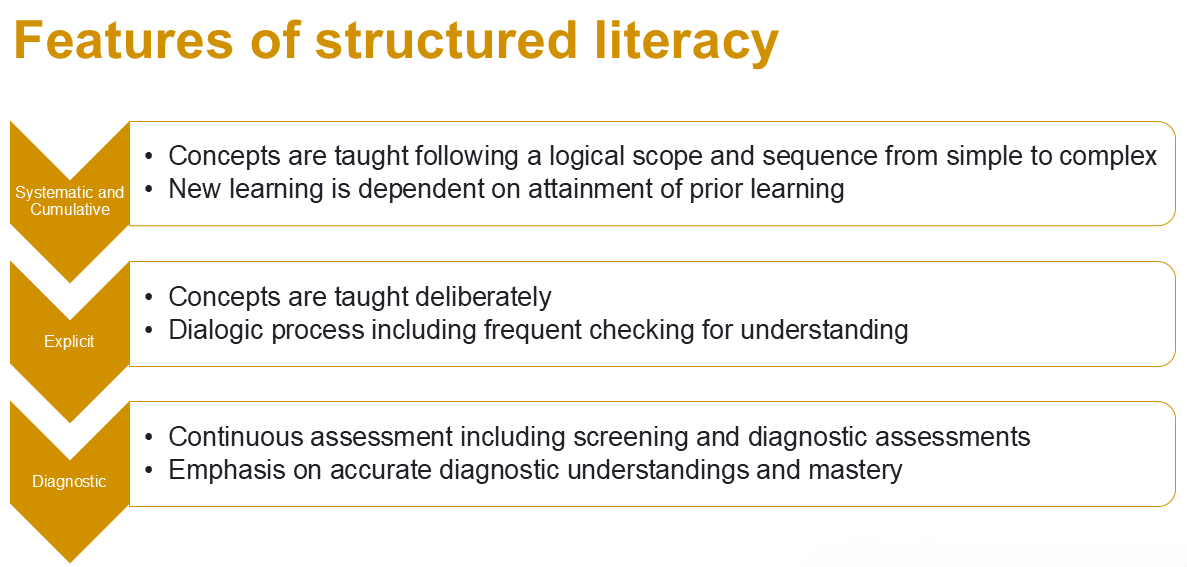
Source – Victorian Academy of Teaching & Leadership
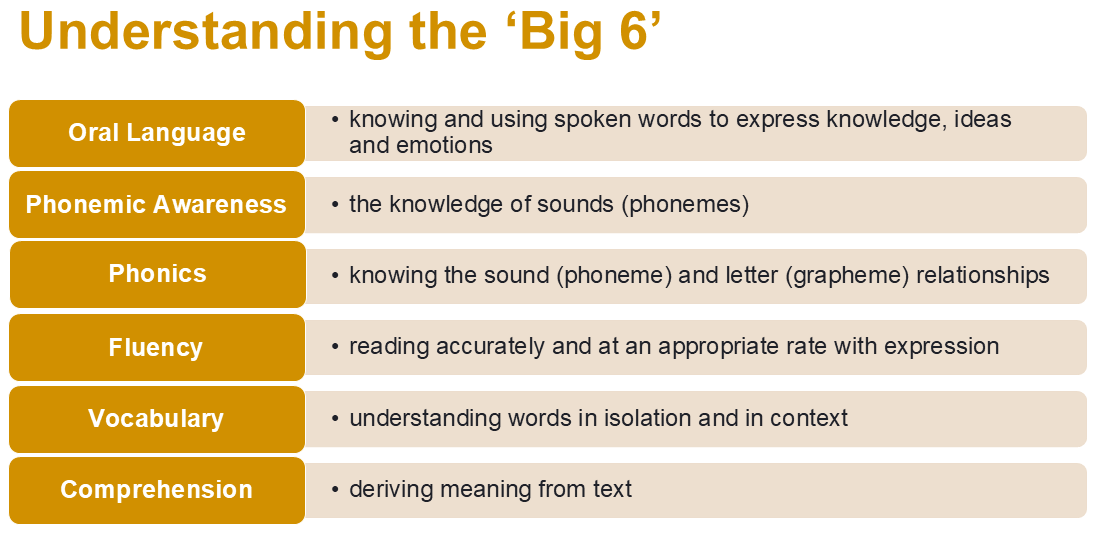
Source – Victorian Academy of Teaching & Leadership
Our instructional model
Literacy is taught daily through a two‑hour literacy block, providing a balanced focus on all components of the Big Six of Literacy. Instruction follows an explicit teaching model with the gradual release of responsibility model (“I Do, We Do, You Do”), ensuring students move from teacher‑led modelling to guided practice, and finally independent application.
Teaching is guided by data, using Department of Education assessment tools, to inform instructional decisions and improve student outcomes. Reading instruction systematically develops decoding, fluency, and comprehension, while writing instruction is structured around the Writing Rope model, integrating transcriptional skills with higher‑level composition. Spelling and grammar are taught explicitly, with teachers using diagnostic assessments to plan targeted support and extension.
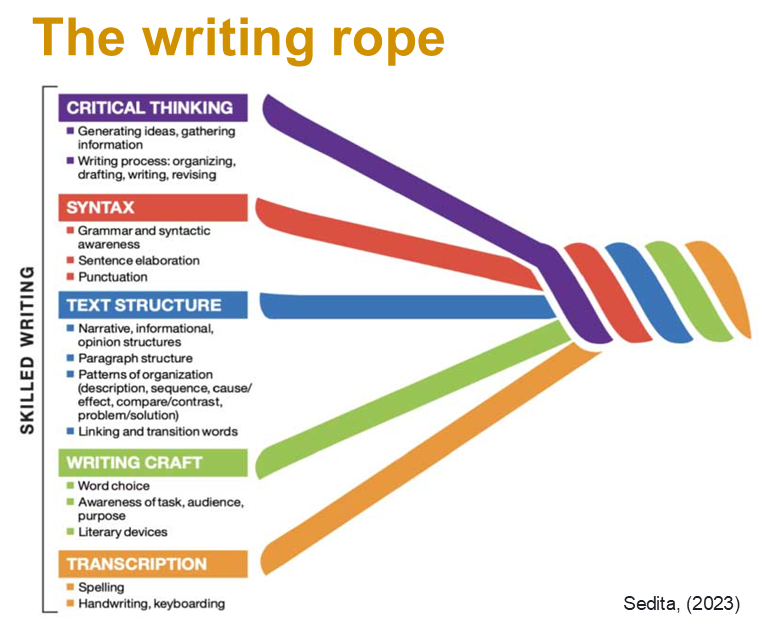
Source – Victorian Academy of Teaching & Leadership
Reading + Writing
Students engage daily in reading and writing activities designed to build knowledge, skills, and confidence. In reading, lessons explicitly address the Big Six components, supported by rich discussions and guided practice with increasingly complex texts. Writing instruction includes modelled, shared, guided, and independent writing, with a strong focus on vocabulary and sentence structure to support clarity and expression.
Handwriting is also an important part of our literacy curriculum. When students are fluent and confident with handwriting, their cognitive load is reduced, allowing them to focus on producing high‑quality writing pieces.
What our students say
“Reading helps me to understand books better and I like being able to talk about them with my friends.”
“I feel proud when I finish a piece of writing and share it with my teacher and my class.”
“Our teacher helps us learn spelling rules and then we practise them in our own writing.”
“We learn grammar and vocabulary that helps me make my writing more interesting.”